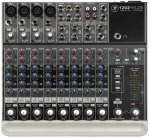
 Another repair from my dad is this Maxie 1202 mixer, a 12 channel analog mixer, that has scratchy/noisy potentiometers, and one channel is reported as pretty much completely dead. Knowing it was all pots, and the unit was going on 20 years old now, I figured it was just dirty.
Taking the mixer apart was relatively time consuming, since you have to pull all the nobs. After removing the back, I did notice that the glue holding down the two power supply filter caps had lost hold, so that was added to my list of fixes (nothing a little hot glue couldn’t fix). I always find it interesting when companies use LM317’s and LM337’s for their power supplies. I guess it does let them set the upper and lower supply rails outside the standard ±5, ±9, ±12, etc.
Total time for disassembly was about 20 minutes. I made sure to index the screws using this handy mat. I also threw all the nobs into a bowl. Interestingly the upper and lower boards of the mixer are joined together by solid core, uninsulated, wire. So I had to keep the upper board slightly elevated from the lower one.
 Late last night, my
  My dad handed me another item to repair this weekend, a Roland GP-100 Guitar Processor, circa mid-1990’s. He reported that it had been acting strangely, so he replaced the backup battery in the unit, but after that, it wouldn’t boot (screen would light, but then it wouldn’t show anything, or respond to controls). To me, symptoms like this always scream power supply problems, and given the age of the unit, to me that meant capacitors. So I agreed to repair it, and brought it home. After confirming the problem myself (you never know how someone’s AC power can influence issues like this), I started looking quickly for the service manual, which I found quickly at