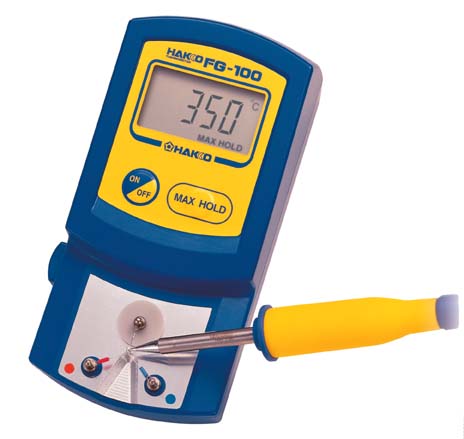
 I recently had my Hakko FR-300 repaired due to a bad heating element, and while I was looking at doing it myself, they mentioned calibration after replacing the element. So, I started looking for how much a soldering tip calibrator would cost (since many thermal probes won’t measure that high). Turned out, there are a ton of fake/grey market Hakko calibrators on eBay for less than $15 shipped from China ((I find the economics of buying stuff cheap from China hard to fathom… How does someone selling this stuff make any money once you factor shipping, etc)). Anyway, I bought one, and waited.
The unit arrived a couple weeks later ((shipped a bit late due to Chinese New Year)), and I must say, it is the most amazing fake I’ve ever seen. The box looked legit (included serial number), the packaging inside looked legit, and the unit itself looks identical to the real thing. The biggest take away is the “Made in Japan” on the back of the unit… which, isn’t very believable. I don’t want to take it apart to look at the soldering (since there’s some spring mechanism involved), but I’d imagine it’s scary. Anyway, the unit is extremely easy to use. You throw a sensor on it (mine came with 10), and then fire up an iron, wet the tip with solder, and place the tip on the sensor “middle”. My recently repaired/calibrated FR-300 read 401C when set to 400C. Cool (the unit claims accuracy of ±3C, and the FR-300 was calibrated to ±10F (approx. ±5C)). So then I tried my Hakko 936 (old and trusty)… setting to 375C resulted in only reading 320! Holy crap, my go to iron was over 50C low, no wonder reworking some joints seemed troublesome. According to the 936 manual, you’re supposed to calibrate at 400C. Turned to that, it remained over 50C off. Luckily, calibration is easy (small phillips screw trimpot under the main knob), and relatively quickly I had it registering correctly.
Final test was my Weller WTCPT tip controlled unit. It SHOULD always be maintain an accurate temperature. I fired it up with a 700F tip installed, and after a couple minutes, checked, and it showed 376C, or 708.8F, which is within spec since the tips are ±9F rated. It did cycle a bit on and off, but well within ±15F, which is fine with me.
While I wish I couple buy a real (or at least legit) Hakko FG-100, I don’t see myself calibrating my irons regularly and only have the two that can be calibrated anyway. =) For less than $15, I’d HIGHLY recommend one. Especially if you don’t know how accurate your iron is.
[xrr rating=4.5/5]
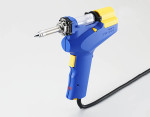 I often find myself repairing electronics that have blown caps, or bad switches, or worse, a bad IC that has 14 to 28 legs. Caps you can cheat and heat one leg, then the other, and work them out (this can be risky, as you risk lifting a pad), and ICs you can cut all the legs and then remove the legs one at a time, but this always felt… desperate. So, when I had the chance to buy a desoldering gun, I jumped on the Hakko FR-300. It replaces the oldy but goody Hakko 808 that people often complained about a short power cord, and other small things. Anyway, Hakko seems to addressed all of these with the FR-300, as it is… awesome.
  Like nearly ever other Racal-Dana 199x owner, I have the mushy/lifeless buttons, so this last week (during vacation) I decided to do the replacement work. It involved unsoldering all the stock buttons (34 of them). Thankfully I have a