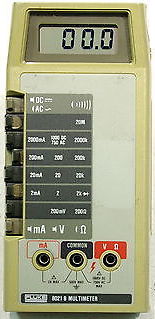
 A coworker recently gave me his Fluke 8021B to repair as it had taken a fall ages ago, and the LCD had been damaged. Having seen a post ages ago on Mr. Modemhead’s site, I knew repairing the screen on the 8020A was doable, and figured the 8021B would be identical as far as screen.
The problem, actually, is the LCD holder is surprisingly different (much more sturdy). So after I ordered and received the LCDs, I went about “machining” the LCD holder to let it fit. This took grinding off part of the “top” where the pins would lay, and several other ribs to allow the LCD to sit “flat” on the holder ((As noted later, I actually didn’t do enough the first go around)). Wiring the LCD, I used two colors of 30AWG wire, and a wire wrap tool (that I hadn’t used before). I used two colors of wire to help differentiate between the bottom and top pins. I also, breaking from Mr. Modemhead’s page, drilled small holes in the LCD holder to feed the “bottom” wires through, and to help keep them in order. Stripping the wires, then soldering to the PCB was annoying, but not overly time consuming. I also had to re-solder the “COM” jack on the unit since it had worked loose enough to “spin”. This is very easy to do, as you just put the soldering iron IN the jack, let the whole thing get nice and hot, and then touch solder to the bottom side, then the top side, and let it cool. I did have to “machine” the plastic of the top case a bit to let it clear the new solder, but it worked just fine, and was now solid. =)
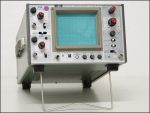 At a local thrift store recently, I came across an “Energy Concepts, Inc” 30820 for next to nothing ($15). They let me plug it in, and I got two traces, so at that point I felt it was worth buying (hell, I would have bought it if it didn’t work, just so I could fix it). Bringing the unit home, and doing some looking around, it appears to be an Iwatsu 5702 (which is why there’s the Iwatsu pictured to the left). I cleaned the unit up (compressed air, and a rag), and went about testing it’s functionality. It appears to have been owned by the local school district, and I confirmed that the High School in question recently received a STEM grant, so it makes sense that they would have upgraded their equipment.
 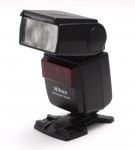 While loading the car for a shoot several weekends ago, I proceeded to drop my Nikon SB-600 from about 2 feet high onto the tile of my mudroom. I thought “crap, hope that survived”, and finished packing. I set up at the shoot, and my wife (who’s the actual photographer) started shooting, but complained the flash wasn’t working. Looking at it, the screen was misbehaving, it would flash inconsistently, and then after trying to power cycle it, it wouldn’t come back on. Uh oh. Shaking the flash, I heard rattling. Crap.