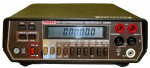
 Given my experience, and eventual success in repairing my now indispensable Keithley 199 Multimeter, I recently picked up a non-functional Keithley 197 Microvolt multimeter on eBay for $25. Vintage is about the same for this model and the 199, and after looking at the manual (which includes schematics), I figured it was worth the $25 to give it a go at repair. Best case, it was easy and I could turn around and sell it, or give it to a friend.
The unit arrived in relatively short order, and indeed, in all settings, the meter just read “OL”. So, first thing that told me is, processor is working. EEPROM too, more than likely. So, going by the manual, and logic, I started with the voltage rails. The 197 has a few. Basically a ±15V rails, a +10V, a +5V analog, a +5V digital, a -6.4V, and a +2V reference. All of these are regulated by diodes rather than more modern LM78xx/79xx regulators. So, going through the checklist, it soon turned up that the -15V (-V) rail was dead. At first I thought diode, but testing the diode out of circuit resulted in a working diode. So something was pulling that rail up toward ground. So, trace time.
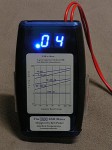 Ever since I started doing LCD monitor, and G5 iMac repair, I’ve wanted/needed to pick up an ESR (Equivalent Series Resistance) meter. Electrolytic capacitors are the bain of pretty much all modern power supplies. Pretty much everything else in a modern power supply is invincible compared to the caps… and while I’ve been extremely lucky that every iMac and LCD monitor I’ve repaired had obviously bad capacitors (bulging), that isn’t always the case… which is where an ESR meter comes in.
 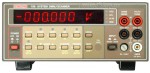 About a month ago, I purchased a broken Keithley 199 multimeter off ebay for about $70 including shipping. From everything I’d read, it was a pretty accurate 5.5 digit, 310,000 count multimeter with a nice bright LED display (as opposed to the Fluke VFD, or HP non-backlit LCD displays). Having bought sight unseen, I wasn’t sure what exactly was broken. It could just be simple user error, or something more serious, but from the age of the unit, it should be fairly repairable.