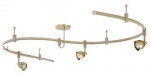
 Since buying our house, we’ve wanted to install track lighting in a few areas of our house, and it’s become more of an interest since my wife has been producing paintings, and photography. So when a local hardware store had a 12″ flexible track lighting pack on sale for half off, we picked it up and brought it home. This was a line voltage pack that used GU10 halogen bulbs. It’s not made anymore, so buying extra fixtures is something we’re having to wait for until the hardware store sells out their stock, and will part with their display unit. Install was kind of a pain on the 12 foot ceilings, and since it’s line voltage, the track is a bit stiff (it has what seems to be 14 gauge wire embedded in the flexible track). If we’d had more than one ladder, it would have been easier since one person could hold an end of the track while the other secures an anchor. As it was, I had to do all the anchors, then put up the track, then move two anchors. If you’re doing it yourself, USE wall anchors. Unless you hit a stud, the ceiling is not sturdy enough to hold the support in place once it’s holding the track. All and all, it went up well, and works well. At first I bought LED lights, but at 3050K, they’re a bit too “white”. I’m still looking for 2700K LEDs. What’s worked well otherwise are the Ikea GU10 florescent lights. They take about 100 seconds to warm up, but they’re nice and warm color temp wise. So, 120v track lighting, I’d give:
[xrr rating=3.75/5]
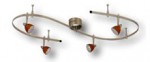 Then, we realize we want track lighting in the hallway. So, we pick up one that’s on sale that’s low voltage. It has a high frequency electronic transformer, and runs MR16 bulbs at 12V. It’s been discontinued, but there are lots of parts available, so we purchase two extra fixtures to make a total of 6. Installation was MUCH easier with the lower ceiling of the hallway, and the much thinner track. My main complaints being that the transformer caused it’s own problems, and that the min-wattage for the transformer to function ((electronic transformers generally have a minimum load that’s required for them to operate correctly)) is 36W, meaning replacing all the lights with LEDs will be a challenge. Right now I’ve got 6 12v-20W Halogens installed, but later I may replace the transformer with a magnetic one that will operate at a much lower wattage, and allow me to use LEDs.
Likewise, but for different reasons, I’d give the low voltage track lighting:
[xrr rating=3.75/5]
Archives for 2012
Radio Shack 22-812 Multimeter
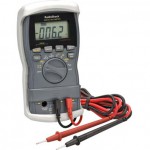 While at the coast a few months ago, I stopped by a Radio Shack and picked up a 22-812 Multimeter for the incredible price of $50 (the RS website doesn’t even list the unit anymore, and the local RS’s have it for $69-79 depending on the display). The unit appears to be out of production (may not be the case), which is a shame since finding a Multimeter with these features, plus a computer interface is nearly impossible for under $150 anywhere else. I’ve had the meter for a few months now, and it seems fairly solid, with a few complaints.
- It’s “twitchy”. When you have it reading a voltage, for example, the last few digits move around a lot. Maybe the voltage actually fluctuates like this, but it seems like it’s noise in the circuitry of the meter. It’s not a major problem, but…
- It blows fuses easily. In my case, it was my fault by trying to measure amperage without a load, but others have complained about this. After I blew the one, I found it came with two extras (one 12A, one 500mA). After blowing the one, and replacing it, I just purchased 10 of each from Jameco, and put them in my supplies for later (I’m sure I’ll blow more).
- It’s not a Fluke (as evident from above)
Now, when I say it’s not a Fluke, that seems obvious from the price. An equivalent Fluke would probably be $400. Would it be worth it? Yes. Can I afford that, or would I use it? No. $50 for what you get, with this meter, is a great price, and I’d buy one again if I had the chance. If I had a few hundred, I’d buy a Fluke and be 100% happy. But for $50, I can be 80% happy, and have saved the money.
[xrr rating=4/5]
Motor coupling on Kenmore Series 80 washing machine
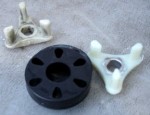 Not going to go very far with this post, since there is a plethora of info out there about doing this job, but I will take the time to point out some issues, and point to resources.
This PDF is probably the best info I could point to, as everything else I found suggested turning the washing machine on it’s side/back, and doing the work from the bottom. But, removing the cowling from the machine was quick, easy, and make the whole job MUCH easier than tipping it over.
My main tips for all this are:
- Sears Parts centers should all have this part in stock. It’s $18. It’s well worth it to pick one up and do the repair yourself using the above PDF as a guide
- When the motor coupling breaks, you’ll often get a heck of a racket when it’s running. BUT! The pump to drain the water usually still runs (since it’s attached directly to the motor, and not the tub transmission). If I’d realized this, I could have saved myself a lot of work by using an aquarium pump to get the water out
All and all, it’s an easy fix. It took me less than 45 minutes to replace the part, and about 15 minutes to drive to and from Sears. So, 1 hour of work, and $18 in parts. Bet a repair man would have charged AT LEAST $100. And, you’ll probably teach yourself something about how the washing machine works in the process. =)