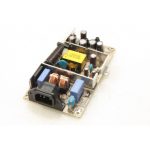
 I have an ancient Dell 1800FP monitor at work that is used for a print release station (users swipe their cards, select their print job, and print it). This monitor runs 24/7, and has probably been running for next to 2 years pretty much solid. The other day, we had a power outage in the middle of the night, and when we came in the next morning and tried to turn the monitor on, it wouldn’t turn on (nothing). Knowing no other option than to try to fix it, I opened it up, and checked the voltage rails (12V and 5V). Both were pulsing on and off about once a second, and the power supply could be heard “ticking”.
I took the unit home (where I have a better setup for soldering/repair) and found several dry/cracked solder joints. Fluxing and reflowing those, however, didn’t fix the issue. Checking the main output caps all showed good as well (ESR all 0.0ohms on my blue meter). Thinking about it some more (what it was doing), it SOUNDED like it was basically starting up over and over again. So I checked the control chip, ICE2AS01 (this seems to be the primary failure on these units), IC901, and it looked fine (no short between ground and VCC). But then I checked its decoupling cap (C907, 47uF 50v): 27ohms ESR. Huh. The decoupling cap (C924, 33uF 25V) for the opto-isolator showed 4ohms ESR. I pulled both, and checked them again (with my DER DE-5000). C924 checked out relatively okay… 4ohms, 30uF (certainly a bit high on the ESR, but the capacitance was within spec). C907, however, was WAY off. ESR measured at 28ohms, and capacitance at 8uF. That’s more resistor than capacitor at this point. Digging through my old boards, I found another monitor supply board that had an exact replacement for C907 (47uF, 50v), and a close replacement for C924 (39uF, 35V). Both fit, and both measured close to 0.1ESR. MUCH better. I popped both in, soldered, and fired the unit up. No clicking, and solid 12V and 5V rails.
Yay, job done. So, while the power outage may not have helped, I’m guessing the unit was probably in this state for a while, and the fact that it was power cycled was the issue. Once that ICE2AS01 is up and running, that decoupling cap probably doesn’t overly matter. But on startup, it’s needed, and there just wasn’t the capacitance there to actually get the IC fired up.
Anyway, this is obviously another failure mode of these old units. And remember, just because there is no sign of bulging for venting doesn’t mean a cap isn’t bad. Just means it may have not failed quite so catastrophically as to vent.
 Okay, last PSU “repair”, I promise (well, until I get another). The bottom of my pile had a Corsair CX600 on it that had shorted out, and nearly fused it’s CPU 12V connection to the motherboard it was attached to. I managed to get it off, but testing the power supply resulted in no output except the +5VSB line. I contacted Corsair, and they quickly set up an RMA for me. I provided them with pictures of the connector, cable, serial number, and picture of my Dr. Power II screen showing no output. I shipped the unit USPS on Saturday, it got there on Monday, they shipped out a replacement that same day, and I had the brand new unit in hand on Wednesday. This was obviously all West coast, but still. I’m pretty amazed by their turn around. Hats off to Corsair.
 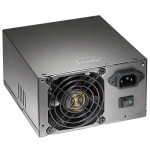 Power supply repair number two, for me, is repairing a unit I’ve had for years, and “works”, but frequently, it will power up the the computer, then almost immediately power it back off, and require flipping the switch on the power supply off and on to get it back “working”. This behavior is indicative of either the Over or Under Voltage/Current latch kicking in (this could be semi-confirmed by unplugging fans, or hard drives from the power supply, and it would start up much more reliably). If the unit did successfully power up, it would run the computer with no problems for weeks/months at a time (I had the unit powering an IPTV box for 6 months previous to teardown for repair). Testing with my