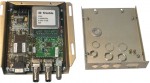
 My quest for a solid 10Mhz signal finally took it’s penultimate step recently, when I purchased a Trimble Thunderbolt GPSDO off eBay.
The unit arrived packed well, and in good shape. It even came with a power connector, which I had not expected. After rewiring it properly (it seemed “off”), I hooked up my Rigol DP832 for the ±12V supplies, and +5V supply, and powered the unit up. Everything looked okay except the +5V rail was drawing about 3x what it should. Oh, and the 10Mhz output being “out” by +26Hz (I wondered if this was because the unit was still powering up, so it didn’t bother disciplining the oscillator yet).
Hooking up a serial connection got no output, and probing the serial connection with the scope showed very low level signals (less than 1Vpp). Opening the unit, I found that the RS232 transceiver (a 232IBE, which is now called a ICL232, or any other number of MAX232 derivatives) was HOT. Everything else looked good for the unit, so my assumption is the chip was damaged. I clipped the leads and replaced the chip with a MAX202 made by TI. It’s pin compatible, but has much better tolerance for ESD and Latch-up (which seemed to be what was going on with the failed chip).
 While I don’t do a lot of RF electronics work, the idea of having a lab standard frequency has appealed to me for some time. Initially, I was drawn to a Rubidium (Rb) standard, which can be had off eBay for $100-$150 or so, but these units are used, and the life left in the lamp is obviously unknown. A Rb standard is accurate to about 1*10-11, or about one millihertz when they’re set to 10Mhz. Not too bad. A GPS oscillator, assuming well designed, should be about an order of magnitude greater, or 1*10-12 ((That said, the Rb standard on short term (a few seconds) will be more accurate, but longer term, the GPS will be much more stable)). Plus, a GPS oscillator shouldn’t really “age” like a Rb, so there should be no need to replace the unit after so many hours of running. Further, Rb standards run hot, and use a fair amount of power (I believe about 10W). But, they “lock” within about 2 minutes of powering on. GPS standards are generally going to take a bit longer than that to lock, if powered on cold (15 minutes or so from my readings), and obviously they also require vision of the sky, but, power consumption should be on the older of 500mW-1W when running, so my inclination would be to let the unit run 24/7, and as a bonus, use it as a time source for NTP.